01
02 · See · Every agent has an owner
AI-agent governance
An AI agent is an identity, and RapidValue governs it like one.
RapidValue finds agents on the platforms where they run. Each agent gets a sponsor, a purpose and an autonomy tier, and RapidValue governs the credentials it holds. The evidence states what each platform can stop and what it cannot.
What changes
What you get
02
More reviews for agents that act alone
03
Every secret listed, and a kill switch
04
What the kill switch cannot stop, in writing
How it works
It works in three steps
Each step records its reason, and the next step uses it.
Register
Record purpose, sponsor, platform and autonomy tier.
Constrain
Govern credentials and permissions through the same access model.
Attest
Review more often when an agent acts alone or reaches more.
Where agents live
RapidValue finds agents on the platform that hosts them and stops them where that platform allows it
RapidValue reads agents from the platforms that host them, imports the sponsor as owner and states per platform what the kill switch can stop.
| Platform | What RapidValue discovers | What the kill switch does | Credentials it sees |
|---|---|---|---|
| Microsoft Entra Agent ID | Agent identities, with the sponsor imported as owner. Copilot Studio and AI Foundry agents are recognised. | Disables the agent in Entra and ends the sign-in sessions of the agent users it owns. | Blueprint secrets and certificates, with expiry. |
| Amazon Bedrock, AgentCore & AWS IAM | Bedrock agents and AgentCore runtimes, plus IAM users you tag as agents. | Attaches a deny-all policy and reads it back. A role shared with other workloads is reported as shared. | Access keys, including when they were last used, and AgentCore token-vault providers. |
| Google Vertex AI & Agentspace | Agent Engine agents and Agentspace agents, plus service accounts you declare as agents. | Disables the agent’s own service account. An agent on the shared Vertex AI service agent, or an Agentspace agent, is found but not stopped, and the kill switch says what to do instead. | User-managed keys. Use is shown as not reported. |
| Salesforce Agentforce | Agentforce agents, limited to the API names you list. | Locks the agent out of RapidValue and states that it keeps running in Salesforce. | OAuth tokens of agent and integration users, by connected app, with their use count. |
| ServiceNow AI agents | AI agents, once you switch the object on. | Locks the agent out of RapidValue and states that it keeps running in ServiceNow. | Refresh tokens and API keys of integration users, and OAuth application registrations. |
| GitHub Apps | App installations you declare as agents, once an organisation owner enables it. | Locks the agent in RapidValue and states that GitHub cannot be stopped from here. | Not reported by GitHub. |
| Self-hosted agents | Registered through intake by a named sponsor. | Revokes the credentials RapidValue issued to it. | RapidValue-issued API credentials. |
When a platform does not report something, RapidValue shows “not reported”. It does not show “never used”.
Early access
A first morning with your AI agents
Start with your agents, and keep your own IGA for people
If AI agents are what worries you most, the first morning starts there. RapidValue works next to the IGA you already run, and the only action it takes on your platforms is the kill switch.
- 09:00
Agree on the question
Which agents and which platforms we look at first.
- 09:30
Connect one people source and your agent platforms
Your HR system or directory for the owners, plus Entra Agent ID, AWS or Google Cloud with a read-and-stop role.
- 11:00
Look at your agents together
Every agent with its sponsor, the ones without an owner and the secrets older than 90 days.
- 11:45
Decide what is next
Owner claims go out, the review rhythm follows each agent’s autonomy, and you see per platform what the kill switch can stop.
Everything you set up here carries over when you later govern people’s access too. Owners, reviews and connections stay.
Shadow AI agents
The agents nobody registered are already in your identity provider
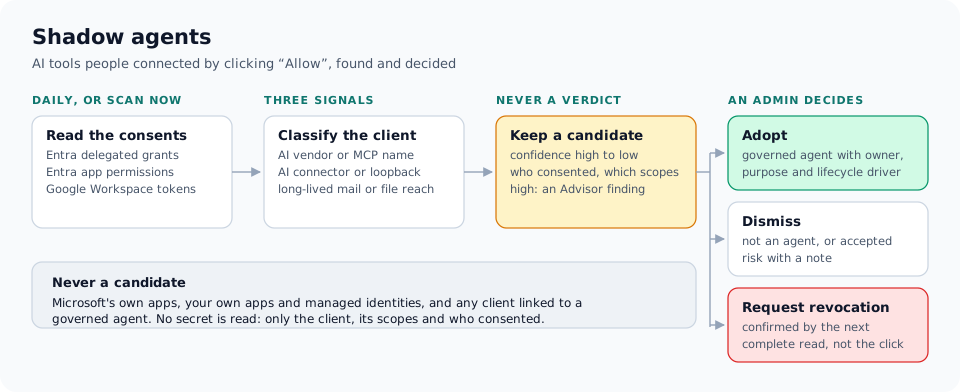
People connect AI tools by clicking “Allow”. Each consent is a standing grant to an agent without an owner. RapidValue reads those consents every day and puts each one in front of an administrator.
A new high-confidence candidate raises a finding for the security team. It closes once the candidate is decided.
1
Read from the consents
The OAuth consents in Microsoft Entra ID and Google Workspace: the client, its scopes and who consented. No secret is read.
2
A candidate, not a verdict
Who the client is, how it connects and what it reaches add up to a confidence. The high ones come first.
3
Adopt, dismiss or revoke
Adopting makes it a governed agent with an owner and a purpose. Dismissing needs a reason, and an accepted risk needs a note.
4
The source confirms it
A revocation counts only when a complete read no longer sees the consent. If the consent comes back, the candidate reopens.
The chain view
From the person who answers for a machine identity to the applications it reaches, in one view
Every non-human identity has a Chain tab, and an AI agent shows the same chain as a strip under its name. It reads in order:
Owner
Who answers for it, and whether that came from an assignment, an ownership rule or the Entra sponsor.
Acts for
The person or team it is declared to act for.
Credentials
The secrets and keys it can sign in with, and their dates.
Tools
The tools it reaches through RapidValue.
Recorded actions
What RapidValue recorded it doing.
Applications
The applications where it holds access.
Each link says whether it is verified, declared or unknown, why it is unknown and how fresh it is. The same chain is a section of the AI-agent evidence pack. Generated for one agent, that pack is the agent’s EU AI Act pack, with an article map that says what it shows and what it does not. The chain shows what RapidValue can see. Tool calls that do not pass through RapidValue are not in it.
Review follows autonomy
The more an agent does on its own, the more often a person reviews it
Every 90 days
Autonomous
Acts without a human in the loop
Every 180 days
Supervised
A human approves what it proposes
Every 365 days
Assisted
Helps a person who acts
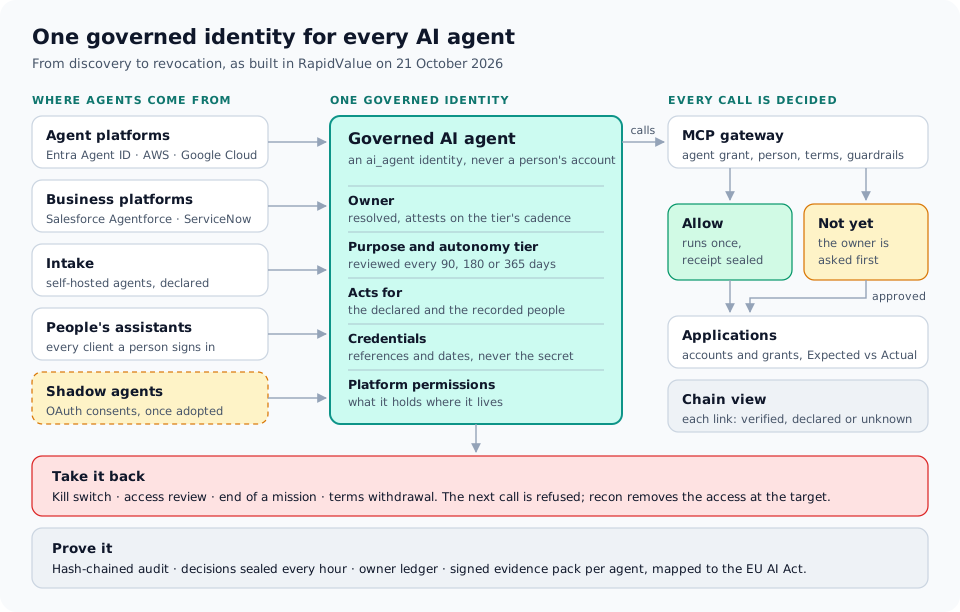
A revoke in that review ends the agent’s access on its next call, just like the kill switch, the end of a mission, the owner withdrawing its terms or stopping a person’s assistant. The AI-agent governance evidence pack collects the trail for your auditor.
Early access
MCP servers and agent tools
A tool call is a form of access, so RapidValue governs it the same way
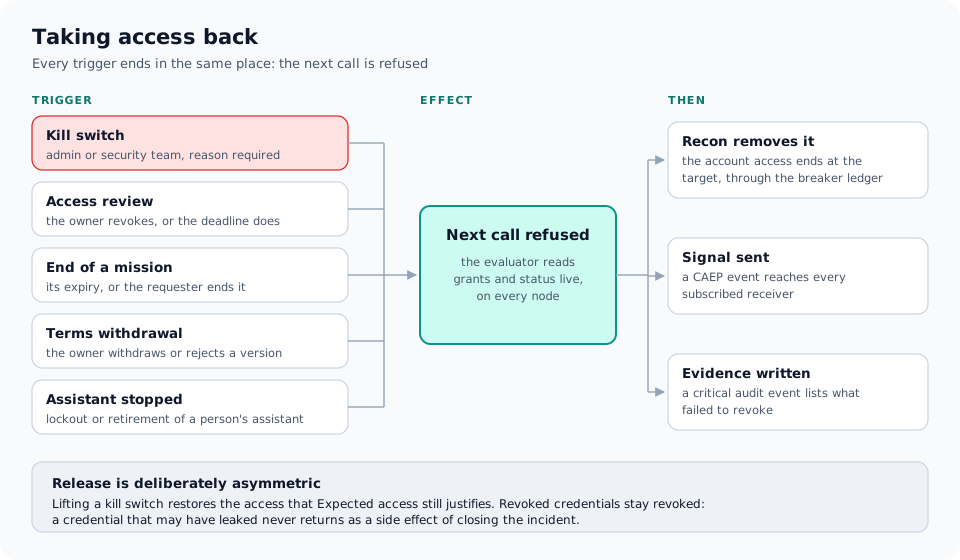
RapidValue runs a gateway in front of your MCP servers and internal APIs. Each tool is an entitlement that is requested, approved, certified and checked for segregation of duties like any other access, and the gateway decides every call against it.
Next on the roadmap: Draft tools that prepare a review decision or a role change for a person to confirm. A model never gets a direct path to a connector.
Every call is decidedThe gateway asks RapidValue before a tool runs and refuses a call the agent is not allowed to make. The refusal states its reason, such as a missing owner, an overdue review or privileged access outside just-in-time.
Terms from the ownerAn agent that meets a system for the first time gets the terms its owner set, and the person accountable for the agent accepts them before it gets access.
The agent never holds the keyAn allowed call gets an authorization that is good for that one call, and the gateway sends the system’s own credential from the vault. An agent that holds that credential itself becomes a finding.
Observe, then enforceEach system starts in observe mode, so you see what would have been refused before the gateway blocks it.
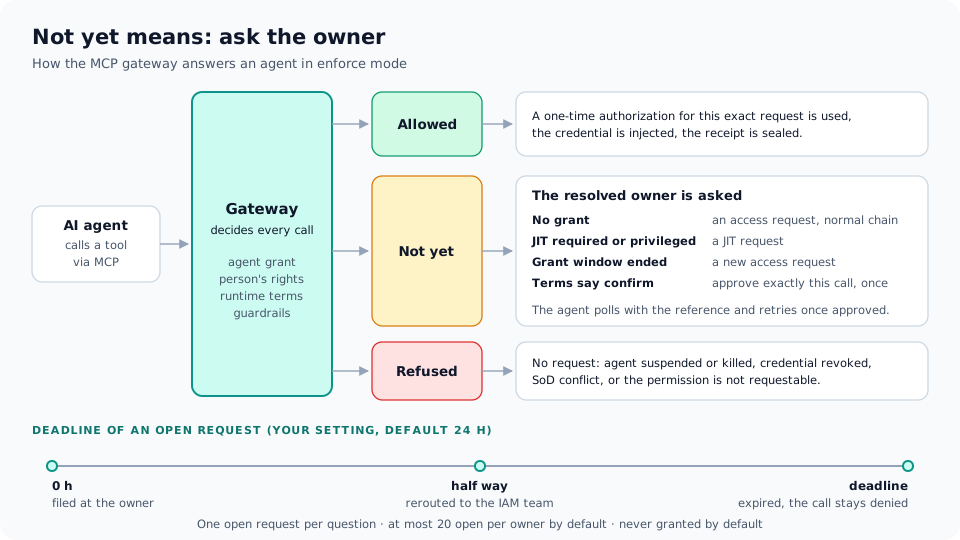
Not yet means the owner is askedWhen the owner can lift a refusal, the gateway files an access request, a just-in-time request or a confirmation of exactly that call. An open request goes to the IAM team at half its deadline. Every decision is sealed every hour.
Your assistant acts for youA person’s AI assistant is decided for two subjects, the assistant and the person. It never gets a right the person does not have, and you can stop it like any other agent.
What we stand behind
The evidence pack supports your governance as a deployer of AI. It is not an opinion on EU AI Act compliance.
Included
Included in every price
There is no module to buy for this. The price depends only on how many identities you govern.
AI-agent governance